

Prostatic growth
Hiperplasia prostática benigna: ¿cuándo es necesario operar y cuál es el mejor tratamiento?
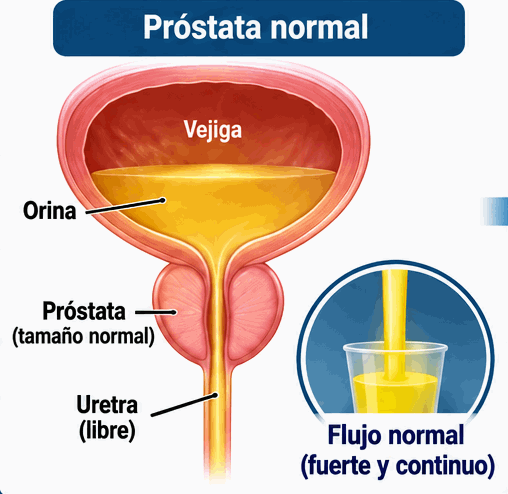
Benign prostatic hyperplasia (BPH), also known as benign prostatic enlargement, is one of the most common urological diseases in men over 50 years of age. It is characterized by the non-cancerous growth of the prostate, which can obstruct urine flow and significantly affect quality of life.
Although it is not cancer, nor does it mean that it will necessarily develop into it, it can cause urinary symptoms that require specialized medical attention.
How common is prostate enlargement?
Prostatic hyperplasia is a process related mainly to aging. It is estimated that histological changes compatible with this disease are present in approximately 50% of men between 50 and 60 years old, and can exceed 80% after 80 years of age.
However, not all men with prostate enlargement have discomfort or need treatment. Among the most frequent symptoms are a decrease in the force of the urinary stream, difficulty starting to urinate, a feeling of incomplete emptying, the need to urinate frequently, and getting up several times during the night.
How is prostatic hyperplasia treated?
Treatment depends on the intensity of the symptoms, the size and anatomy of the prostate, the presence of complications, and the patient's preferences.
In mild cases, it may be sufficient to modify some habits and maintain medical surveillance. When symptoms are more significant, medications can be used that relax the prostatic musculature or progressively reduce its volume.
Surgical treatment is considered when medications do not provide sufficient improvement, the patient prefers an interventional solution, or complications appear, such as urinary retention, repeated urinary infections, bladder stones, or deterioration of renal function associated with obstruction.
Currently, there are minimally invasive procedures and endoscopic techniques that allow treating prostate enlargement without making external incisions.
Three modern treatments: Rezūm, TURP, and HoLEP
- Rezūm: water vapor treatment
Uses water vapor to controllably destroy part of the prostatic tissue that obstructs the exit of urine. It is a minimally invasive procedure that can be performed on an outpatient basis and generally allows for the preservation of ejaculatory function.
Its main disadvantage is that the improvement is gradual, it may require a temporary catheter, and it offers less intense de-obstruction than resection or enucleation techniques. It is considered mainly for prostates of 30 to 80 milliliters, especially when preserving ejaculation is a priority.
- TURP: transurethral resection of the prostate
It is one of the most used and studied surgical techniques. Through an instrument introduced through the urethra, the prostatic tissue that causes the obstruction is removed.
It provides significant and relatively rapid improvement of symptoms. It is the gold standard surgical treatment for prostates of 30 to 80 milliliters. Its disadvantages include the risk of bleeding, retrograde ejaculation, and the eventual need for a second intervention.
- HoLEP: Holmium Laser Enucleation of the Prostate
It is an advanced endoscopic technique that uses laser energy to separate and remove practically all the obstructive prostatic tissue, preserving the prostatic capsule.
Its main advantage is that it can be used on prostates of practically any size, even when there is very significant growth. It offers long-lasting results, less perioperative bleeding, and, frequently, shorter hospital stays than conventional surgery.
Its limitations include the need for specialized equipment, a significant learning curve for the surgeon, and the risk of retrograde ejaculation and transient urinary incontinence.

What is the best procedure?
There is no ideal technique for all patients.
Rezūm may be especially attractive for men who wish to preserve ejaculation and are looking for a less invasive intervention. TURP continues to be an excellent option for intermediate-sized prostates, with widely demonstrated efficacy. HoLEP stands out for its ability to treat large prostates and offer broad, long-lasting obstruction relief.
The choice should be made after a urological assessment that includes symptom intensity, prostate size, prostate anatomy, and patient expectations.
The goal of treatment is not only to improve the urinary stream, but to recover quality of life, protect bladder function, and prevent long-term complications.
The importance of a specialized assessment
A timely diagnosis allows for identifying the most appropriate treatment and preventing symptoms from progressing to cause complications.
If you experience difficulty urinating, a decrease in the strength of your urinary stream, or the need to get up frequently during the night, schedule a urological assessment. There are modern, safe, and effective alternatives that can help you regain your well-being.